
Comparisons / Guides
Fish Games vs Slots: What’s the Difference & Which Fits You Better?
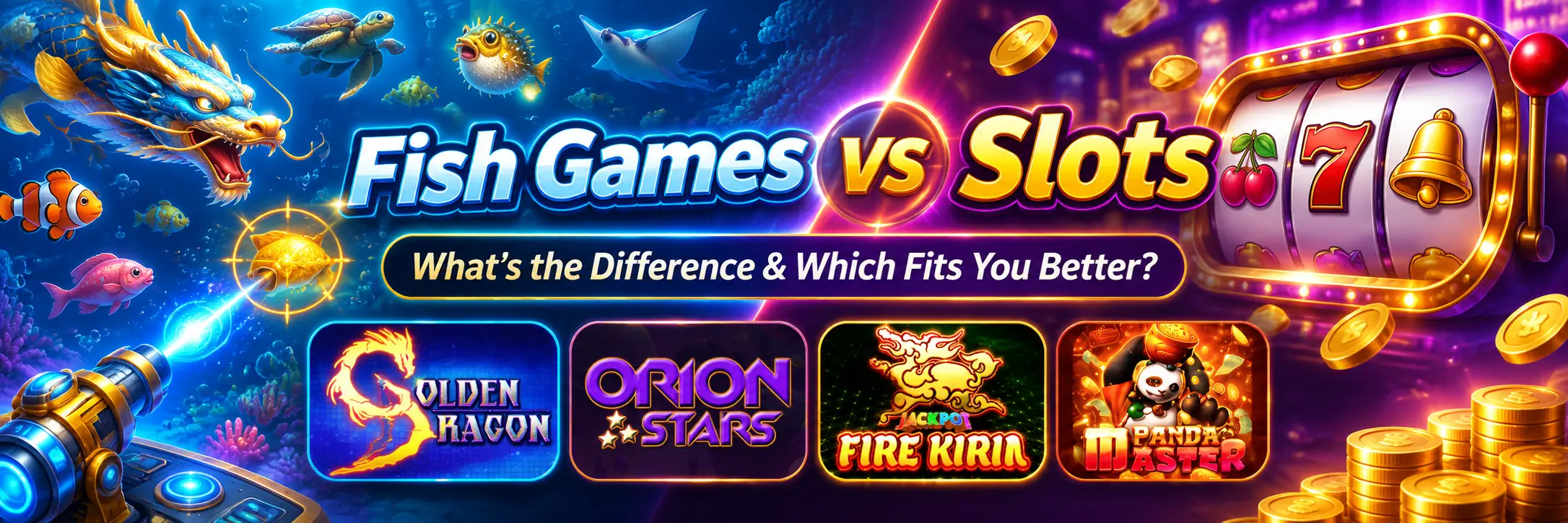
Fish games and slots can sit side by side in the same lobby, but they ask different things of you.
A fish game can involve continuous interaction with moving targets and may charge for each shot. A slot is built around individual spins, with a stake you select before a paid round starts.
Fish games give you more direct controls. That does not establish better odds or higher returns.
The better fit depends on whether you want active, ongoing play or simpler spin-based rounds.
Fish Games vs Slots: Key Differences at a Glance
| Feature | Fish games | Slots |
| Main format | Moving targets, arcade-style action | Reels and symbols |
| Main action | Aim, fire, interact | Select a stake and spin |
| Pace | Can be continuous | Individual rounds |
| Balance use | May be charged per shot or action | Usually charged per paid spin |
| Player input | More active controls | Usually fewer controls |
| Automated features | Auto-fire in some titles | Autoplay or turbo spin in some titles |
| Rules | Vary by title | Vary by title |
| RTP and odds | Title-specific | Title-specific |
| Better odds? | No category-wide advantage established | No category-wide advantage established |
| Beginner fit | People who like active controls | People who prefer simpler rounds |
The central difference is how you participate.
A fish game keeps you involved while targets move across the screen. A slot asks you to choose a stake, start a spin and wait for that round to resolve.
What Are Fish Games?
Fish games are arcade-style titles built around moving targets, usually in an underwater setting.
You use an on-screen shooter or cannon to aim and fire as targets cross the play area, and a title can deduct balance with each shot.
Some fish titles also use a shared play area where several players can fire at the same targets at once.
Shot costs, target behavior and available controls differ between titles.
For the full mechanics, see the How to Play Fish Table Games guide.
What Are Slot Games?
Slot games use reels carrying symbols.
You select a stake, start a spin, and the game resolves the result according to that title’s rules.
The interaction is usually simpler:
- Choose the amount
- Press spin
- Read the outcome
Individual slots differ in reel layout, symbol combinations, paylines and features.
Some include:
- Wild symbols
- Multipliers
- Free spins
- Bonus rounds
None of those is guaranteed across the category.
The paytable or information screen tells you which features a particular game has and what conditions apply.
The structural point is that slots are organized into separate rounds. You don’t need to keep aiming at moving targets while a round is underway.
Fish Games vs Slots: The Main Gameplay Difference
The difference becomes clearest once play starts.
In a fish game, the screen can stay active with targets moving through the play area.
Depending on the title, you may choose:
- Where to aim
- When to fire
- Which target to engage
- Whether to adjust a cannon or shooting level
Your involvement continues as the action unfolds.
A slot follows a more contained sequence.
You select a stake and start a spin. The reels move, the game resolves, and you decide whether to begin another round.
In standard base-game play, most core decisions happen before or between spins, although some titles can include feature-specific choices.
This doesn’t mean fish games give you control over outcomes, or that slots offer no choices.
The two formats ask for different kinds of input.
How Balance Is Used
Fish Games
A fish game may use balance per shot or per action.
Each time you fire, the game may deduct the displayed shot cost.
A title offering different cannon or weapon levels may charge different amounts depending on the setting.
Slots
In paid base-game slot play, balance is generally committed per spin.
The selected stake is applied when that paid round starts.
Bonus rounds, free-spin features or other game-specific features may work differently, so check the title’s paytable and rules.
Neither format has one universal cost.
A fish title sets its own shot values, while a slot sets its own stake options.
Check what the game displays rather than assuming every title prices the same way.
Which Can Commit Balance Faster?
The useful number is the amount committed over time: the cost per action combined with how often that action occurs.
A fish title that allows rapid or held fire can produce several paid actions in quick succession.
That does not predict the ending balance because results are resolved according to the individual game’s rules.
Slots still resolve play one round at a time, although some titles can automate or speed up consecutive spins.
The amount committed over time in either format depends on:
- The title
- Its settings
- Automated features
- Action frequency
For a fish game, work out the cost per action and how often you intend to take that action before you start.
One without the other tells you very little.
Does More Interaction Mean More Skill?
Fish games involve more active input.
You may aim at moving targets, choose when to fire, select a target or adjust a cannon setting where the title offers one.
Slots generally involve fewer decisions within a standard round: select a stake, start a spin and see the result.
That difference can make fish games feel more skill-oriented.
More interaction does not automatically mean more control over the outcome.
GoodGDragon doesn’t treat aiming, target selection or shot timing as proof that a player can change a game’s RTP, expected return or long-term outcome probabilities.
Those mechanics depend on the individual title and its rules.
Some titles have specific mechanics affecting how a shot behaves or what it costs. The game’s own help panel is where to check them.
How Much Control Do You Have in Slots?
A slot’s outcome is determined by the game’s internal mechanics.
Choosing a stake or deciding when to press spin doesn’t mean you control which symbols appear in that round.
You still make real decisions, including:
- How much to stake
- Whether to continue
- When to stop
Those decisions are not the same as controlling the result.
Slot rules and features vary by title, and the paytable or information panel is where to check how a specific game works.
Which Has Better Odds: Fish Games or Slots?
There’s no verified category-wide evidence that fish games offer better odds than slots, or the reverse.
Format alone doesn’t establish a game’s expected return.
A fish game has moving targets and shooting options.
A slot has reels, symbols and a paytable.
Neither description tells you which has better odds.
Target size, shot value, stake size and number of controls are not substitutes for the actual game rules.
Fish Games vs Slots RTP
RTP, where it’s disclosed, is a figure for an individual title.
It shouldn’t be treated as one fixed percentage covering every fish game or every slot.
Where a provider discloses RTP or return information, use the figure only for the exact title and version it applies to.
It shouldn’t be generalized across fish games or used to assume that aiming accuracy changes expected return unless the game’s own rules establish that.
GoodGDragon doesn’t publish a verified category-wide RTP figure for either format, so there’s no basis for claiming one category averages higher.
Be cautious of third-party percentages that don’t identify the exact game, version and source.
Which Is Easier for Beginners?
Slots may feel simpler if you want a small number of controls and clearly separated rounds.
The basic process is:
- Choose a stake
- Spin
- Read the result
- Decide whether to continue
The stake is visible before each paid round, which makes the immediate cost easier to identify.
Fish games may appeal if you prefer active controls and moving targets.
The extra interaction makes the screen busier, and understanding the cost of a shot matters because you may take many actions during a session.
Neither format is established as easier to win on.
Choose based on the controls you understand and the pace you’re comfortable with.
Which Suits Shorter Sessions?
Slots can be easier to pace manually because play is organized into individual spins, although autoplay or faster-spin settings can reduce those natural decision points.
Fish games can involve more continuous action, which can make it easier to lose track of how often actions are committing balance.
That’s a pacing difference, not a cost verdict.
Your stake or shot value and your own habits matter more than the category.
Set a stopping point before you start in either format.
Fish Games vs Slots on Mobile and Desktop
Both formats can be available through GoodGDragon-supported platforms, but the experience depends on the platform, title, device and browser.
Fish Games on Mobile and Desktop
On mobile, fish games can involve frequent touch interaction because you’re aiming and firing at moving targets.
Screen size and control placement can affect how comfortable the interface feels.
On desktop, a larger display gives more room to track moving targets and controls.
Slots on Mobile and Desktop
Slots generally use a more contained control layout than fish games, although the interface and usability can still vary by title, device and browser.
A bigger display does not by itself establish different odds or expected return.
It mainly changes how much screen space you have for the controls and game interface.
Where You’ll Find Fish Games and Slots on GoodGDragon
GoodGDragon documents both fish-style and reel-style games across several connected platforms.
Fire Kirin publishes a catalogue you can browse before opening the platform, which makes its current mix easier to inspect in advance.
Orion Stars, Milkyway and Panda Master are documented as carrying both formats.
For more detail on Panda Master, see the Panda Master guide.
The Milkyway guide also documents fish games and reel-style titles.
Golden Dragon is associated with both formats, but the current selection available through GoodGDragon should be checked inside the PlayGD lobby rather than taken from a fixed external list. See the Golden Dragon games guide for that distinction.
Libraries change, and platform availability can change too.
Check the current lobby and platform-card status rather than working from a game list published elsewhere.
For the broader platform comparison, see the Best Fish Game Platforms on GoodGDragon guide.
Can One Platform Have Both Fish Games and Slots?
Yes.
A single platform can carry moving-target fish games and reel-based slots in the same library.
Sharing a platform doesn’t mean sharing:
- Rules
- Return figures
- Balance behavior
- Controls
A fish title may charge per shot, while a slot can deduct a selected stake per paid spin.
Check the information screen for each individual game.
Which Should You Choose?
Choose fish games if you prefer:
- Active interaction
- Moving targets
- More frequent on-screen decisions
- Continuous-style gameplay
Watch the cost of repeated shots.
Choose slots if you prefer:
- Individual rounds
- A simpler control layout
- Reel-based gameplay
- A decision point between manually started spins
Neither format is financially superior simply because of the category.
The better fit is the format whose controls, pace and cost structure you understand and can manage.
Should You Switch Formats After Losing?
There is no verified basis for treating a switch from one format to another after a loss as a way to improve expected outcomes.
Moving from slots to fish games after a losing session does not by itself establish better odds, and the reverse is also true.
Treat each game as its own title and stop at the limit you set.
Common Fish Games vs Slots Myths
Bigger fish mean better value.
Not established. A larger or higher-value target may require multiple paid shots, so size alone doesn’t make it more efficient to pursue.
Better aim improves your return.
Not established. Aiming changes where you direct your shots, but that alone doesn’t establish that expected return improves.
Slots always have worse odds.
No category-wide evidence supports that, in either direction.
A higher shot setting improves your chances.
A higher setting changes what you commit per action. It isn’t established that it changes what comes back.
Switching formats after a losing run improves your chances.
There’s no verified basis for treating a format switch as a way to improve expected outcomes.
Responsible Play in Both Formats
For Fish Games
Find the cost per shot before firing and factor in how often you intend to fire.
Continuous play can make it easy to lose track of how much you’ve committed, so set a session limit in advance.
For Slots
Check the stake per spin and don’t raise it to chase a previous loss.
When you’re playing manually, the point between spins can be used as a decision point to stop or continue.
If a title offers autoplay or similar automation, monitor it separately rather than assuming the game will create that pause for you.
For Both
- Take breaks
- Stop at your planned limit
- Don’t chase losses
- Treat neither format as a source of income
See GoodGDragon’s Responsible Gaming information for account controls and support resources.
For independent U.S. support and responsible-gambling resources, visit the National Council on Problem Gambling.
Fish Games vs Slots FAQs
What’s the Main Difference Between Fish Games and Slots?
Fish games involve active interaction with moving targets through aiming and firing.
Slots use reels and individual spins, with a stake selected before each paid round.
Are Fish Games Better Than Slots?
Not universally.
Fish games offer more continuous interaction, while slots have simpler spin-based rounds.
The better fit depends on your preference, not a proven financial advantage.
Do Fish Games Have Better Odds Than Slots?
GoodGDragon doesn’t publish evidence that either category has better odds.
Return information is specific to individual titles where disclosed.
Which Can Commit Balance Faster?
Fish games can allow frequent player-triggered shots, while slots generally use a stake per resolved paid spin.
Automated features can change the pace in either format, so compare the controls and action frequency of the specific title.
Are Fish Games Skill-Based Compared With Slots?
They involve more player input, such as aiming and choosing when to fire.
That doesn’t prove skill changes RTP or long-term outcome probabilities across titles.
Are Slots Easier for Beginners?
They may feel simpler because the main action is selecting a stake and spinning.
Neither format is established as easier to win on.
Can One Platform Have Both?
Yes.
Several GoodGDragon-supported platforms document both formats.
Available games and rules vary by platform and individual title.
Should I Switch From Slots to Fish Games After Losing?
There’s no verified basis for treating a format switch after a loss as a way to improve expected outcomes.
Open the current GoodGDragon platform lineup and choose a fish-style or reel-style game based on the kind of interaction you prefer — not on claims that one category gives better odds.
Players must be at least 18, or the age of majority in their jurisdiction if higher. Availability depends on location and play is void where prohibited.
Sweeps Coins have no cash value until redeemed under the applicable rules, and verification may be required for certain features and for redemption.
No purchase is necessary to enter or win, and a purchase does not increase your chances of winning.
Review the current Sweepstakes Rules, Terms & Conditions and Responsible Gaming information before participating.