
Guides
How to Play Fish Table Games Online: Beginner Guide
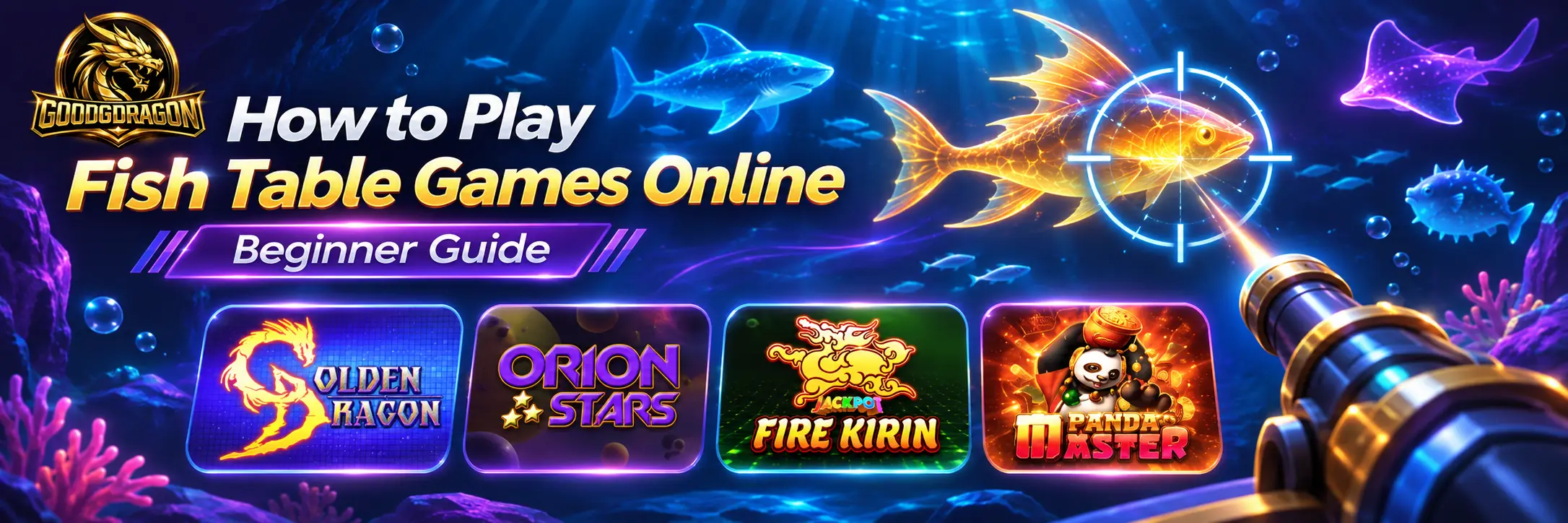
Fish table games are interactive games where moving targets cross the screen and you use an on-screen cannon to fire at them. Each shot can use part of your game balance, and successful hits are resolved according to the rules of that specific title. Where a slot generally resolves play one spin at a time, a fish game can involve continuous interaction with moving targets.
Before you play, open the game’s own help screen. Shot costs, target values, weapons and special features differ from one title to another, and the title’s own rules, help screen and paytable are the primary sources for how that specific game works.
What Are Fish Table Games?
Fish table games are arcade-style titles built around an underwater scene. Targets move across the screen, you control an on-screen shooter or cannon, and you fire at them as they pass.
The core elements most of these titles share:
- A moving field of targets
- An on-screen cannon you aim and fire
- A visible balance that changes as you play
- An in-game help or information panel describing that title’s rules
What varies is almost everything else. Shot costs, target values, weapon options, bonus features and how results are calculated are set per title. Two games that look similar can still use different costs, controls and mechanics, so check the specific title’s own rules rather than transferring assumptions from another game.
Why Are They Called “Fish Tables”?
The name comes from the table-style arcade format: many physical fish games use a large shared screen built into a cabinet with multiple player control positions.
Online versions kept the “fish table” name even though you now play on your own screen.
How Does a Fish Game Session Work?
The basic loop is similar across the category, even though the controls differ:
- Open a fish-style title from a platform’s game lobby.
- Read the in-game help or rules panel before anything else.
- Check your current balance as the game displays it.
- Check the cost per shot.
- Select a shooting level if the title offers one.
- Aim at the targets you want.
- Fire.
- The game resolves each hit according to its own rules.
- Keep checking the balance as you play.
Step 2 is especially important because control layouts, shot costs and button labels aren’t standardized across titles.
What Does Each Shot Cost?
This is one of the most important concepts for a beginner to understand.
A fish game can deduct from your balance every time you fire — not once per round, but once per shot. If a title lets you change cannon or weapon level, a higher setting may use more balance per shot.
To make the arithmetic concrete, purely as an illustration: if a game displayed a shot cost of 1 credit, firing ten shots would use 10 credits before any results are taken into account.
That’s an example of how per-shot pricing works, not a statement about what any particular game charges. Base costs differ by title, so check what the game itself displays rather than carrying a figure over from somewhere else.
Find the shot cost before your first shot, not after.
Why Can a Fish Game Balance Drop Quickly?
Slots generally resolve play one spin at a time. Where a title uses per-shot pricing, the game may continue deducting balance for each shot while you’re firing, which changes how quickly a balance moves.
Held or Repeated Fire
Keeping the fire control down can send many shots in a few seconds. Each one may carry its own cost.
Auto-Fire
Where a title offers auto-fire, it may continue firing and consuming balance until you stop it or until the game’s own rules end the action.
Check the title’s controls before using it.
Practical habits that help:
- Check the cost per shot before you start
- Don’t hold the fire control until you know what each shot uses
- Glance at the balance periodically rather than only at the end
- Decide a session budget in advance and stop at it
What Do Fish Values and Multipliers Mean?
A fish game may display numbers, values, multipliers or visually distinct target classes. These indicate how the game evaluates particular targets.
What they do not tell you is what a single hit will return.
A visible multiplier is not a guarantee attached to one shot. How a target’s displayed value translates into an outcome — how many hits it takes, what triggers a result and how the value is applied — is set by that title’s rules.
Use the game’s own rules, help panel and paytable rather than transferring assumptions from another title.
A game may also visually distinguish ordinary targets from larger or special ones. It does not follow that a larger target is more worthwhile to pursue.
A visually larger or higher-value target may require multiple paid shots depending on the game, so size or displayed value alone does not establish that the target is more efficient to pursue.
Check three places before drawing conclusions:
- The in-game help screen
- The paytable
- The rules or information panel
What Are Boss Fish and Special Targets?
Some titles include boss targets, special creatures, event targets or bonus objects that behave differently from the ordinary field.
These may trigger additional effects, animations or game-specific features.
What they trigger, how they’re reached and what they’re worth are title-specific, and boss mechanics aren’t standardized across the category.
If a page tells you how to handle “boss fish” without naming the game, it may be describing one title’s behavior as though it applied everywhere.
What Are Cannon and Weapon Levels?
Some fish games let you adjust shot value, cannon level, weapon strength or firing mode. A higher displayed level may increase the cost per shot.
Some titles also include special weapons or power-ups such as:
- Area effects
- Rapid fire
- Lasers
- Bombs
- Temporary weapons
These are possible features, not standard ones.
Not every fish game has them, and where they exist, the effect and the cost belong to that title.
What can’t be said about any of this is that a stronger cannon improves the underlying return, that a higher weapon level increases long-term winning chances, or that one level is mathematically optimal.
Those claims require an authoritative rule set for the exact title.
The setting changes what you commit per action. It is not established that it changes what you get back.
Do Fish Games Require Skill?
Fish games involve more direct player input than a reel spin.
You choose:
- Where to aim
- Which targets to engage
- When to fire
- Which shooting level to use where one is offered
- When to stop
That’s a real difference in how you interact with the game.
It is not the same as a claim that player skill changes the underlying return or produces better results across fish games generally. GoodGDragon doesn’t publish evidence for that, and outcome mechanics are defined by each individual title.
The accurate version is that you have more decisions available to you than in a slot. What those decisions do to the mathematics depends entirely on the game.
Is There a Winning Fish Game Strategy?
There is no GoodGDragon-verified universal strategy, timing pattern or shooting sequence that guarantees wins or profit across fish games.
Unless a strategy claim is supported by the official rules or verifiable technical information for the exact title and version, treat it as unverified.
That applies to shooting patterns, timing systems, target sequences and “hacks” sold online.
What Can You Actually Control?
You can control:
- Understanding the shot cost before you fire
- Reading the game’s rules
- Watching the balance as you play
- Not firing continuously without knowing what it uses
- Setting a session limit and keeping to it
Those are balance-management practices.
They affect how long your balance lasts and how much you commit. They are not a winning system.
Does a Higher Shot Value Improve Your Odds?
Using a higher shot value changes how much balance you commit per action where the game supports that setting.
GoodGDragon does not publish evidence that increasing shot value improves the underlying chance of a successful outcome across fish games.
A larger stake is a larger stake.
Treat it as a cost decision, not an odds decision.
Are Fish Games Better Odds Than Slots?
There is no verified GoodGDragon category-wide return figure for fish games.
Treat any general fish-game RTP figure cautiously unless the source identifies the exact titles, versions and methodology behind it.
Game mathematics depend on the specific title, and a category-wide comparison would require data neither format publishes in aggregate.
Common Beginner Mistakes
Not Checking the Shot Cost
Firing repeatedly without knowing what each action costs can make it easy to lose track of how quickly the balance is being used.
Holding the Fire Control
Continuous fire can use credits quickly.
Raising the Weapon Level Without Checking the Cost
A higher setting may cost more per shot. Check before you change it.
Assuming a Target Is “Due”
Don’t assume a target is due simply because you’ve already fired several shots at it.
Whether earlier hits matter depends on the exact title’s documented mechanics.
Following Patterns and Hacks Found Online
Treat any strategy claim not supported by the exact title’s official rules as unverified, whatever the page promises.
Ignoring the In-Game Rules
Different titles behave differently.
Use the game’s own rules, help panel and paytable rather than transferring assumptions from another title.
Playing Past Your Own Limit
A limit you move is not a limit.
Fish Table Games vs Slots
| Feature | Fish games | Slots |
| Main interaction | Aim and fire at moving targets | Start a reel spin |
| Pace | Can involve continuous interaction | Generally one spin at a time |
| Cost | May apply per shot or action | Usually per spin |
| Player input | More active controls | Bet and spin controls |
| Automated features | Auto-fire in some titles | Autoplay in some titles |
| Rules | Vary by title | Vary by title |
Slots generally resolve play one spin at a time, while fish games can involve more continuous on-screen interaction.
Some titles in either category may offer automated features, so check the specific game controls.
Can You Play Fish Games on Mobile?
Platforms supported by GoodGDragon open through their own access routes, and several of those routes work in a mobile browser.
Whether a specific title works well on a phone depends on:
- The platform
- Your device
- Your browser
- Your current account setup
Fish games use more on-screen controls than a reel game, so the experience can differ between a phone and desktop even on the same title.
Check the individual platform guide for the access route used by that platform.
For example, the Panda Master guide and Milkyway guide explain the browser-based access flows for those platforms.
Where Can You Play Fish Games on GoodGDragon?
GoodGDragon documents fish-game availability on several platforms.
Fire Kirin publishes a browse-first catalogue you can look at before opening the platform, while Orion Stars, Milkyway and Panda Master are documented as carrying fish-style games.
Other connected platforms may also show fish titles in their current live libraries.
Because platform catalogues and availability can change, check the live lobby for the selection available to your account and look at the platform’s current card status before counting on it.
For a deeper platform-by-platform breakdown, see the Best Fish Game Platforms on GoodGDragon comparison.
How Does Your GoodGDragon Balance Work With Fish Platforms?
GoodGDragon uses Sweepstakes Coins, held in three separate balances:
- Purchased SC
- Bonus SC
- Redeemable SC
They have different eligibility characteristics, and only Redeemable SC is what withdrawals are drawn from.
The Purchased SC, Bonus SC and Redeemable SC guide explains those balances in detail.
Recharge
Recharge moves eligible SC from your GoodGDragon wallet into a supported connected game.
Redeem
Redeem moves eligible game balance back to your GoodGDragon wallet.
Withdraw
Withdraw is a separate action from the wallet rather than from the individual game.
Redeem is not a withdrawal.
The controls available to you can vary by platform and account, so use the current controls shown in your GoodGDragon account.
Responsible Play for Fish Games
A fish game may apply a per-shot or per-action cost rather than a single round-based stake, which makes a few habits especially useful:
- Know what each action costs before you start
- Set a budget for the session and treat it as fixed
- Set a time limit as well as a money limit
- Don’t increase your shot value after a losing run
- Take breaks away from the screen
- Stop when it stops being entertainment
GoodGDragon’s Responsible Gaming information covers available account controls and support resources.
For independent U.S. responsible-gambling information and support, see the National Council on Problem Gambling.
How to Start Playing a Fish Game on GoodGDragon
- Sign in to your GoodGDragon account.
- Open a platform that’s currently available in your lobby.
- Use that platform’s own access flow — the steps aren’t identical across platforms.
- Open its live game lobby.
- Pick a fish-style title.
- Read its rules or help panel.
- Check the shot cost and your current balance.
- Start at a shooting level you understand.
- Keep an eye on the balance while you play.
Individual platform guides cover the platform-specific access step.
Fish Table Games FAQs
What Is a Fish Table Game?
A fish table game is an interactive arcade-style game with moving targets and on-screen shooting controls.
The exact mechanics vary by title.
How Do Fish Games Work?
You fire at moving targets using your game balance, and the title resolves each interaction according to its own rules.
Why Are They Called Fish Tables?
The name comes from the table-style arcade format — a large shared screen built into a cabinet with multiple player positions.
Online versions kept the name.
Does Every Shot Cost Credits?
A fish game may apply a per-shot or per-action cost rather than a single round-based stake.
Check the specific title for what it charges.
Are Bigger Fish Better to Target?
Don’t assume so.
A visually larger or higher-value target may require multiple paid shots depending on the game, so size or displayed value alone doesn’t establish that it’s more efficient to pursue.
Do Fish Games Require Skill?
They involve more player input than a reel spin.
GoodGDragon doesn’t verify that skill changes the underlying return across fish titles.
Is There a Guaranteed Fish Game Strategy?
No.
There is no GoodGDragon-verified universal strategy that guarantees wins or profit across fish games.
Do Fish Table Cheats or Hacks Work?
No verified universal cheat, hack or shooting pattern is established for GoodGDragon fish titles.
Avoid software, scripts or third-party services claiming guaranteed outcomes or access to hidden game mechanics.
Are Fish Games Better Odds Than Slots?
There’s no verified category-wide answer.
Treat any general fish-game RTP figure cautiously unless the source names the exact titles, versions and methodology behind it.
Where Can I Play Fish Games on GoodGDragon?
Fire Kirin publishes a catalogue you can check in advance.
Orion Stars, Milkyway and Panda Master are documented as carrying fish games.
Other platforms may show fish titles in their live libraries, so check your current GoodGDragon lobby.
For the detailed comparison, see the Best Fish Game Platforms guide.
Can I Play Fish Games on My Phone?
Several supported platforms have mobile-browser routes, subject to your device, browser and platform availability.
How Do I Avoid Using My Balance Too Quickly?
Find the shot cost before you fire, avoid holding the fire control, check the balance as you go, and set a session limit before you start.
Sign in to GoodGDragon, open a platform currently offering fish-style games, read the selected title’s rules and check the shot cost before you begin.
Players must be at least 18, or the age of majority in their jurisdiction if higher. Availability depends on location and play is void where prohibited. Verification may be required for certain features and for redemption.
No purchase is necessary to enter or win, and a purchase does not increase your chances of winning.
Review the current Sweepstakes Rules, Terms & Conditions and Responsible Gaming information before participating.